







Many founders know the pattern: hours spent writing articles and developing campaign ideas, followed by little or no measurable customer growth.
The usual reason is straightforward: there is no clear strategy.
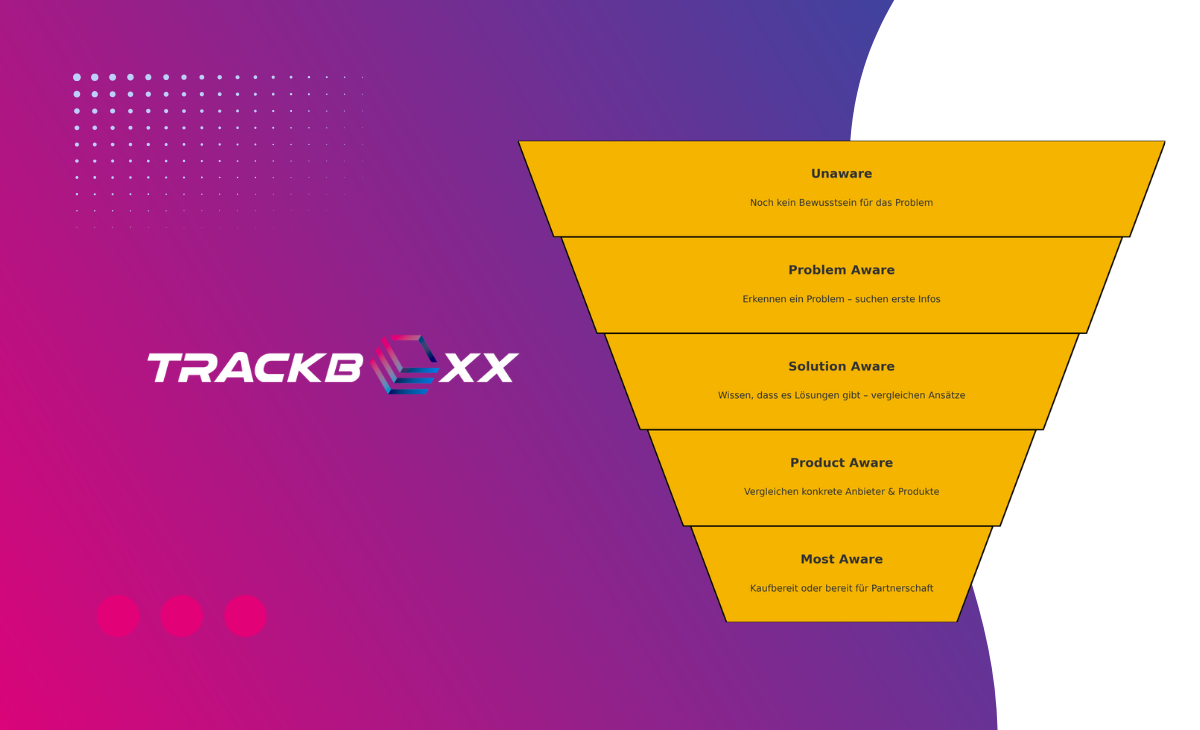
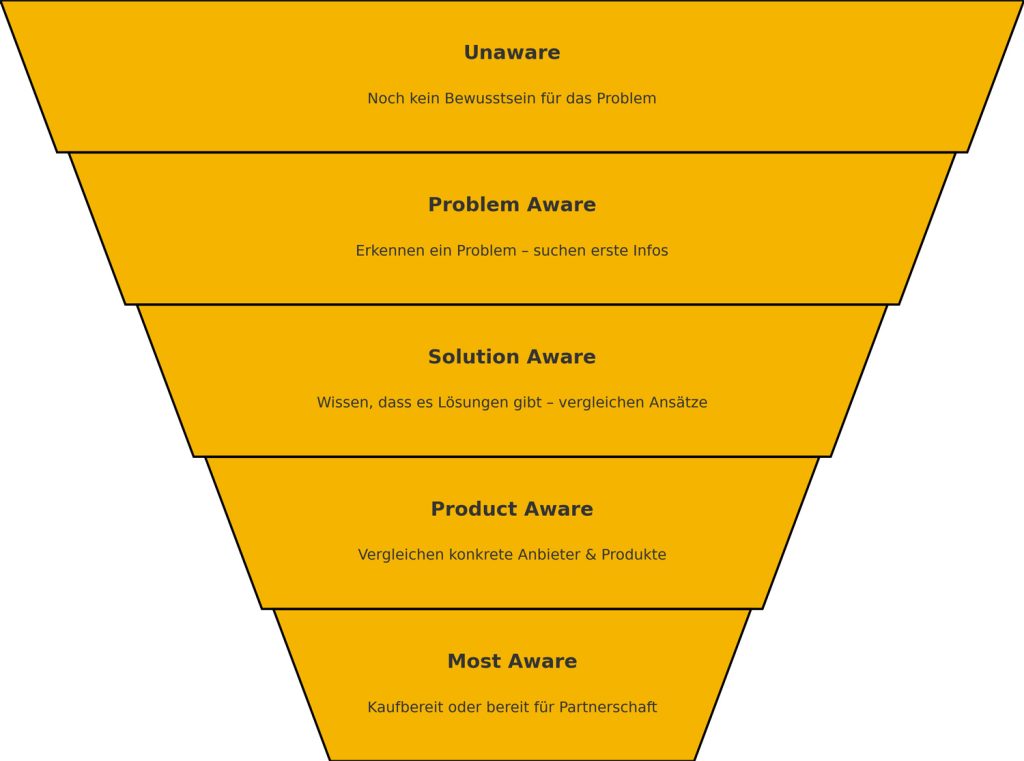
Instead of publishing disconnected articles, build your content around the five levels of customer awareness described by Eugene Schwartz in Breakthrough Advertising.
This framework is particularly useful for SaaS start-ups that need to focus limited resources on content with commercial potential.
The five levels of customer awareness
| Level | What the prospective customer knows | Suitable content and examples |
|---|---|---|
| Unaware | The audience has not yet recognised the underlying problem | “How can I become a better salesperson?” / “Tips for growing a successful business” |
| Problem Aware | The audience knows that a problem exists | “How can I organise my leads?” / “Five ways to close more sales” |
| Solution Aware | The audience knows that software solutions exist | “Five leading CRM platforms” / “The best affordable CRM tools” |
| Product Aware | The audience knows your product but is still comparing options | “Bump vs Salesforce” / “Alternatives to HubSpot” |
| Most Aware | Buyers, specialists and advisers who already understand the market | Partner programmes, integration guides and detailed feature content |
Where should founders begin?
One of the most useful lessons from the framework is:
Begin with solution-aware and product-aware content.
Why?
- This is where you reach prospects who are ready to buy.
- They already know that they need a solution and are now looking for the right provider.
- Pages such as “Alternatives to HubSpot” or “Bump vs Salesforce” can directly support that decision.
Useful content formats to start with:
- Comparison articles, such as “CRM X vs CRM Y”
- Alternative pages, such as “Seven alternatives to Salesforce”
- Curated lists, such as “Ten CRM tools for small businesses”
- Product-specific guides, such as “Zapier integration” or “CRM for construction companies”
A common mistake: starting too high in the funnel
Many founders begin by investing in unaware-stage content, including broad topics such as “How can I become a better salesperson?”
The problem is that these readers are not yet ready to buy , so converting them may take months or even years.
If you need results sooner, focus on content for prospects close to a purchase decision.
Content marketing is a long-term investment
Another factor matters just as much: Timing.
- Content marketing often takes five to eight months to produce measurable results.
- A founder with fewer than ten customers may be better served by faster feedback channels, such as direct outreach and customer conversations, before investing heavily in content.
Putting it into practice: measure content with Trackboxx
A content strategy reaches its full value only when its performance is measurable. This is where an analytics platform such as Trackboxx can help:
- Analyse bounce rate: How many readers leave after the first article? This can indicate whether the content is reaching the intended audience.
- Measure time on page: Do readers engage with a solution-aware article or leave almost immediately? This provides a useful relevance signal.
- Track conversions: Which articles generate the most demo requests, newsletter subscriptions or trial accounts?
- Understand the customer journey: Which content introduces visitors to your business, and which articles help turn them into customers?
Tip: add clear calls to action, such as “Request a demo”, to relevant articles and measure their performance.
Content marketing vs paid advertising
| Criterion | Content Marketing | Paid Ads |
|---|---|---|
| Cost | Up-front investment with lower long-term acquisition costs | Immediate cost for every click or impression |
| Effect | Compounding traffic and leads over time | Short-term results that continue only while the budget is active |
| Trust | Can build strong credibility through demonstrated expertise | Often receives less trust because the placement is paid |
| Measurability | KPIs such as CTR, bounce rate, conversions | Highly detailed measurement through advertising dashboards |
| Lasting impact | Evergreen articles can attract traffic for years | Traffic stops when the advertising budget stops |
Conclusion and recommendation
Content marketing works best when it is aligned with the customer’s level of awareness.
Founders should begin with prospects close to making a purchase, particularly at the Solution Aware and Product Aware stages.
A framework alone is not enough:
- Define clear KPIs including conversions, time on page and click-through rate.
- Use an analytics tool such as Trackboxx to evaluate content continuously and improve what is not working.
- Combine content with paid campaigns to balance immediate reach with sustainable growth.
Done well, content marketing becomes more than a source of website traffic. It becomes a sustainable engine for growth across the business.
FAQ: content marketing and the five levels of customer awareness
What are the five levels of customer awareness?
The five levels are Unaware, Problem Aware, Solution Aware, Product Aware and Most Aware. They describe how close a prospective customer is to a purchase, from being unaware of the problem to being ready to choose a product.
Which awareness level should my content target first?
For many SaaS start-ups, it makes sense to begin with Solution Aware and Product Aware — these prospects are actively seeking a solution and may convert sooner.
Why does unaware-stage content often perform poorly?
The audience has not yet recognised a specific problem. Broad content may build reach, but it rarely produces conversions in the short term.
How do I measure the success of my content strategy?
With tools like trackboxx you can measure metrics such as Time on Page, bounce rate and conversions — helping you see which articles generate leads and which need improvement.
How long does content marketing take to deliver results?
A common benchmark is five to eight months before a measurable return appears. Early-stage founders should therefore combine content with faster acquisition methods such as paid campaigns and outbound sales.